
Company’s platform technology will introduce genetic tools to improve nitrogen use efficiency
WEST LAFAYETTE, Ind. — Novin AgriTech, a startup whose platform combines agricultural expertise and biotechnology to develop novel traits for cereal crops, has received an eight-month, $174,906 Small Business Innovation Research (SBIR) Phase I grant from the U.S. Department of Agriculture’s (USDA) National Institute of Food and Agriculture.
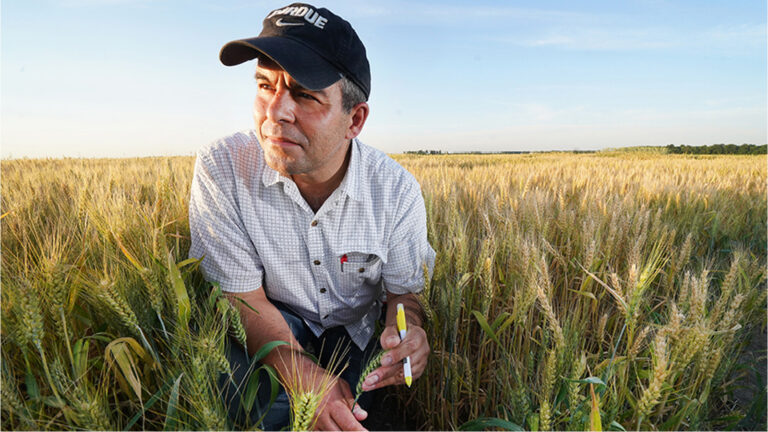
Mohsen Mohammadi, co-founder of Novin AgriTech, is the wheat breeder and an associate professor of plant breeding and genetics in Purdue University’s Department of Agronomy in the College of Agriculture. He leads Purdue’s soft red winter wheat breeding program, with research focused on improving grain yield, enhancing resistance to Fusarium head blight and dissecting the genetics of sustainability traits.
Mohammadi developed two patented cereal transformation platforms: InPACT, Novin AgriTech’s core platform, and a nanoparticle-assisted ultrasound gene delivery system. They enable direct genetic manipulation of elite wheat germplasm. He and his colleagues will use the SBIR funding to develop the nitrogen use efficiency (NUE) trait and introduce it into elite wheat cultivars.
“The project will reinforce Novin AgriTech’s positioning as a platform company,” he said. “Our mission is to empower the cereal crop ecosystem with practical, scalable and future-ready solutions that tackle the evolving challenges of food security, health, resource efficiency, and crop resilience to biotic and abiotic stresses.”
Benefits of the funded project
Mohammadi said the eight-month SBIR-funded project will culminate in several strategic advantages for Novin AgriTech.
- Technical validation of core platform. “Successful delivery will demonstrate our genotype-independent, tissue culture-free transformation platform can be applied to a commercially critical trait: NUE and farm-ready cultivars,” Mohammadi said. “This major proof point will show the platform is fast, trait-relevant and scalable across elite wheat varieties.”
- Platform expansion to other traits and crops. “Once validated for NUE, the same workflow can be rapidly extended to other complex traits like abiotic stress and disease resistance, and other crops like barley, oat and sorghum,” he said.
- Acceleration toward commercialization. “By identifying the promising early-generation plants within eight months, the project significantly de-risks downstream development and shortens timelines to field trials and regulatory positioning, especially in gene-editing-friendly markets like the United States,” he said.
- Strengthened partnering and investment positions. “Demonstrating NUE improvements in wheat, the most widely cultivated food crop in the world, provides compelling validation for strategic partnerships with ag biotech companies and nondilutive funding including additional grants from the federal government and venture investors,” Mohammadi said. “The project also directly supports discussions with other companies by providing data-backed credibility.
“In summary, completion of this project will transform the technology from technology demonstration into a high-value product by validating real-world nitrogen efficiency gains; reducing adoption risk; and strengthening Novin AgriTech’s positioning for Phase II funding, industry partnerships and market entry,” Mohammadi said.
Other Novin AgriTech milestones
Mohammadi said Novin AgriTech recently established a Cooperative Research and Development Agreement (CRADA) with the USDA. He said InPACT has been advanced in part through this collaboration.
“This CRADA milestone provides us (a) strong collaborative USDA-Agricultural Research Service environment, further advancing the technology to mutually shared objectives such as gene editing techniques,” he said.
In 2023, the Purdue Innovates Trask Innovation Fund awarded Mohammadi $47,773 to support the research that led to InPACT technology and the subsequent launch of Novin AgriTech.
“The funding helped my colleagues and I to strengthen InPACT with more molecular data,” he said.
Mohammadi disclosed his inventions to the Purdue Innovates Office of Technology Commercialization (OTC), which applied for patents to protect the intellectual property. OTC licensed the technologies to Novin AgriTech.