
2026 Velocity empowers innovators to build tech solutions in bioinnovation, farmer-focused innovation, food is health
AgriNovus Indiana, an initiative to grow the agbioscience economy, released new research today identifying critical challenges ripe for innovation that will serve as the foundation for the 2026 Velocity Accelerator, a six-month program that awards entrepreneurs three separate $25,000 cash prizes for their technology solutions in bioinnovation, farmer-focused innovation and food is health.
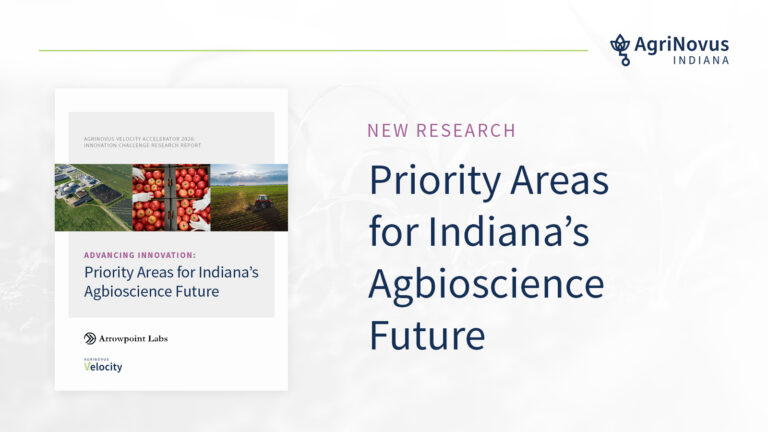
Conducted by Arrowpoint Labs, the study entitled Advancing Innovation: Priority Areas for Indiana’s Agbioscience Future, updates the sector’s economic impact in Indiana, synthesizes insights from key state and national agbioscience leaders and provides problem statements for the innovation community – from students to startups and existing companies – to solve through Velocity.
“Velocity is an accelerator that focuses on the core challenges facing our agbioscience industry,” said Christy Wright, president and CEO of AgriNovus Indiana. “This study defines where Indiana is best positioned to lead and gives participants the tools they need to create purpose-built, scalable technologies. We look forward to working with our entrepreneurial ecosystem to drive progress in these focus areas.”
According to the study, there are three challenge areas for innovators to address through innovation for this year’s accelerator:
BioInnovation
Develop technology that unlocks powerful markets for bio-based products, including focuses on gene editing for operational simplicity, mid-scale biomanufacturing and fermentation infrastructure, and agricultural waste stream biorefinery transformations.
Challenges to address include:
- Advance gene editing technologies delivering enhanced crop traits (climate resilience, nutritional density, nitrogen-use efficiency) through improved seed varieties that minimize operational change requirements.
- Advance technologies enabling modular, flexible mid-scale fermentation and bioprocessing infrastructure that support pilot and scaling of precision fermentation, microbial strain engineering, and bio-based chemical production domestically.
- Develop enzymatic hydrolysis, fermentation, and chemical conversion technologies transforming high-volume agricultural waste streams into high-value bioplastics, biochemicals, specialty food ingredients, and advanced materials at commercial scale with positive economics.
Farmer-Focused Innovation
Leverage technology to assist farmers with some of the most critical issues facing their operations; including farm data intelligence and interoperability, regulatory navigation and compliance automation, and human-out-of-loop automation for labor-intensive operations.
Challenges to address include:
- Build unified farm data platforms that consolidate 500,000-plus daily data points from fragmented systems into predictive decision support tools that demonstrate clear ROI and integrate seamlessly with existing farm operations.
- Develop automated compliance and regulatory navigation platforms that reduce time burden of complex EPA pesticide point systems, conservation program paperwork, and multi-jurisdictional requirements while maintaining farmer access to essential chemistry and economic incentives.
- Create autonomous equipment and AI-enabled robotics for complex farm tasks (specialty crop harvesting, livestock management, processing operations) that deliver under two-year ROI, mitigate skilled labor needs, and integrate with existing farm infrastructure.
Food is Health
Develop and accelerate innovation that increases food and nutrition access and enables food as a driver of health, giving opportunities across the agricultural and health care value chains to positively impact healthier lives, communities and environment.
Challenges to address include:
- Build platforms connecting farmers to healthcare payers, CPG companies, and health-conscious consumers that enable transparent pricing premiums for nutrient-dense crops, identity-preserved supply chains at commercial scale, and measurable clinical outcome tracking.
- Develop data collection, integration, and analytics platforms demonstrating measurable clinical outcomes (ER visit reduction, hospitalization decrease, medication use reduction) from food interventions, enabling sustainable business cases for health care payers beyond temporary grant funding.
- Develop protein-enriched ingredients and functional food components that integrate seamlessly into existing CPG manufacturing processes while improving macronutrient profiles and meeting consumer requirements.
Presented by Indiana Corn Marketing Council and Indiana Soybean Alliance, Velocity’s three tracks are guided by research and strong mentorship throughout the six-month accelerator. The program will culminate with a demo day event and winning check presentations in October. Companies, individuals and entrepreneurs who want to apply to participate in Velocity can access more information and an application link here. The deadline to register is May 1, 2026.
To read the full study and get more information on the Velocity challenge scopes, click here.