Labor remains one of the greatest challenges facing the economy. Solinftec is addressing the problem with autonomy and artificial intelligence focused on improving crop performance. Today we are joined by their Chief Global Strategy Officer, Leo Carvalho, to talk accelerating in a crowded market and creating a value proposition for farmers.
Leo gets into the company’s evolution since its expansion to the U.S. — from developing technologies to identify problems to new solutions that also solve them. As a technology company, he also stresses the importance of creating concepts that are tested, refined and – candidly – co-created by farmers. The launch of their Solix sprayer addresses all the things Leo says Solifntec aims to accomplish: to create more food, sustainably, while also making the farmer more profitable.
As a seventeen-year-old Brazilian company that started in the sugar industry, Leo talks about lessons learned as they’ve grown and expanded into new markets. Farmers plant crops once a year, so listening to their needs is critical to timely success. Leo also shares Solinftec’s objectives for the future and how agtech will continue to evolve.
Food and Drug Administration confirms Bovaer meets safety and efficacy requirements
Elanco expects product launch and added carbon credit value to producers beginning in the third quarter
Elanco announces agreement with dsm-firmenich to expand distribution of Bovaer across North America, adding both the Canada and Mexico markets
Elanco Animal Health Incorporated (NYSE: ELAN) today announced the U.S. Food and Drug Administration (FDA) has completed its comprehensive, multi-year review of Bovaer® (3-NOP), a first-in-class methane-reducing feed ingredient, and determined the product meets safety and efficacy requirements for use in lactating dairy cattle.
“This monumental announcement has the ability to accelerate the opportunity for climate-neutral dairy farming while creating a new revenue stream for dairy farmers across the country,” said Jeff Simmons, President and CEO, Elanco Animal Health. “We appreciate FDA’s commitment to maintaining high standards for science-based review, while balancing the need to quickly bring solutions to the market. Bovaer represents another example of Elanco being a partner of choice in animal health, where the capabilities of our talented R&D, regulatory and commercial teams are delivering significant value.
Simmons continued: “As global temperatures breach new thresholds, consumers demand more sustainable products and the farm economy battles profitability challenges, we are excited to bring Bovaer to the market as a potential solution. Bovaer will create value for farmers, while helping food companies meet consumer demands and deliver on their sustainability commitments. As animal, human and now environmental health continue to converge, Bovaer is one of the most significant innovations that considers this intersection and provides consumers, farmers and society what they want for our future.”
Bovaer represents another blockbuster potential innovation in Elanco’s portfolio and further accelerates livestock sustainability, the next billion-dollar plus market in animal health. This innovation is expected to accelerate market development and increase innovation in this space.
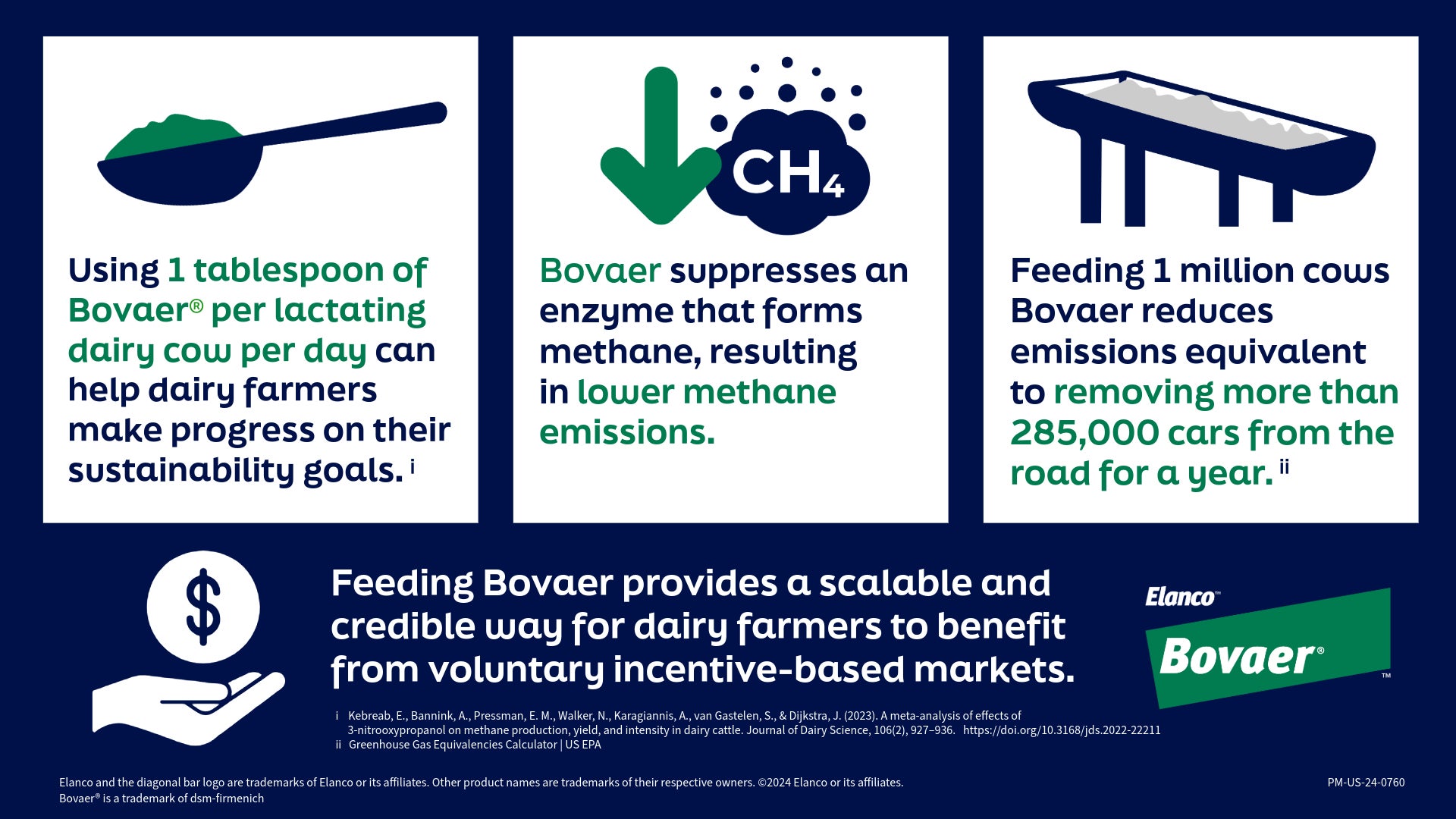
Bovaer works by suppressing the enzyme in the cow’s rumen that forms methane. Feeding one tablespoon of Bovaer per lactating dairy cow per day can reduce methane emissions about 30% or about 1.2 metric tons of carbon dioxide equivalent (CO2e) emissions annually, while creating opportunity for dairy farmers to be financially rewarded for reducing their dairy’s carbon footprint.1 Feeding one million cows Bovaer would reduce emissions equivalent to removing more than 285,000 cars from the road for a year.2 Feeding Bovaer to cattle has proven to be safe for animals, producers and consumers.
Expanding Access Across North America
Elanco and dsm-firmenich have agreed to expand Elanco’s commercialization of Bovaer across North America. In addition to the U.S., Elanco will also now have the right to market Bovaer in Canada and Mexico, where the product is already available for use in beef and dairy cattle. This expanded agreement can accelerate the opportunity to make climate-neutral cattle farming in North America a reality this decade.
“We congratulate Elanco and the U.S. dairy sector, on this important milestone, and will support Elanco by providing initial supplies from Europe,” said Dimitri de Vreeze, CEO at dsm-firmenich. “This strategic collaboration exemplifies how we can accelerate the expansion and adoption of Bovaer in North America to significantly decrease methane emissions on a large scale, and thereby support global efforts to combat climate change. Bovaer holds the key to a transformative shift in the global dairy sector, and launching this feed ingredient in the U.S. after years of dedicated research, trials, and industry collaboration is a testament to its global potential.”
Simmons said, “We appreciate the work dsm-firmenichhas invested in this revolutionary product and are pleased they’ve recognized Elanco as the global farm animal health leader and the right partner to bring this solution to farmers across North America.”
Why Methane Matters
This announcement comes at a pivotal time. According to the United Nations, the world’s population has until the year 2030 to curb greenhouse gas emissions (GHG) or deal with irreversible impacts to the planet.3 In response, about two-thirds of all Fortune 500 companies have set significant climate commitment goals.4 Reducing enteric methane emissions from cattle—naturally generated through the enteric fermentation process—represents a key opportunity. Methane lasts about a decade in the atmosphere and is 27x more potent than carbon dioxide at trapping heat—so smaller reductions create greater impact on temperature.5 By mitigating methane, the livestock industry can reduce the rate of climate warming and allow food companies and retailers to make meaningful progress toward their Scope 3 emissions goals.
“Reducing enteric methane is critical if we are to reach our climate goals,” said Dr. Frank Mitloehner, CLEAR Center Director and University California Davis Professor and Cooperative Extension Air Quality Specialist. “It’s exciting our farmers will have an important tool to do that, in Bovaer.”
Creating New Revenue Streams for Farmers
Feeding Bovaer to cows provides a scalable and credible way for dairy farmers to benefit from being good stewards of the environment by being financially rewarded for implementing on-farm sustainability interventions.
“At an added cost of a few cents a gallon of milk, Bovaer can help food companies meet their climate commitments and consumer desire for more sustainable dairy products,” said Katie Cook, Vice President, Livestock Sustainability and Farm Animal Marketing at Elanco. “Meanwhile, by engaging in voluntary carbon markets and securing USDA and state conservation programming, dairy producers have a scalable sustainability practice with the potential to create an annual return of $20 or more per lactating cow by feeding Bovaer6. Our goal is to make this opportunity a reality starting this summer, while creating a self-sustaining carbon inset market for American agriculture.”
Dairy farmers incorporate Bovaer into their rations and quantify the effect using carbon market-friendly tools like UpLook™ by Elanco, an insights-based engine designed to quantify greenhouse gas emissions reductions. The tool utilizes on-farm data and peer-reviewed science to identify key drivers of an operation’s carbon footprint and track the progress of sustainability efforts. UpLook connects seamlessly to Athian, the first-of-its-kind livestock carbon inset marketplace. This seamless process allows farmers to quantify their emissions reduction efforts and certify carbon credits for sale. In addition to the carbon marketplace, the U.S. Department of Agriculture has awarded $89 million in funding to support farms using technologies like Bovaer to reduce their methane emissions.7
“Products like Elanco’s Bovaer will allow U.S. farmers to be rewarded for participating in voluntary, producer-led sustainability efforts,” said Gregg Doud, President and CEO, National Milk Producers Federation. “Consumers around the world are demanding lower-carbon foods. Bovaer is an innovation that can help U.S. dairy farmers remain globally competitive and maintain their role as leaders in more sustainable dairy production.”
Greg Bethard, a dairy farmer from Kansas who has used UpLook to quantify his greenhouse gas emissions, expressed his excitement around today’s announcement.
“Dairy producers have made great strides improving the sustainability of our operations,” said Bethard, High Plains Ponderosa Dairy. “Today’s announcement provides access to a product that has been extensively studied and shown to reduce emissions from dairy cows. Bovaer is a value-creation opportunity for dairies—it’s about helping us provide product in a manner most of our consumers are wanting—a lower carbon footprint food.”
It’s May in Indiana and major headlines abound as The Greatest Spectacle in Racing coupled with the Global Economic Summit (GES) put the state on the world’s stage – for racing spectators and innovators alike. Today, Mitch Frazier and Cayla Chiddister recap the month including major news in the agbiosciences from Elanco, Purdue, Elevate Ventures and Traction Ag.
Elanco and Purdue announced a OneHealth Innovation District as part of the company’s new campus west of downtown Indianapolis. The facility is designed to deliver and scale up innovation where industry and academia can collaborate including office, wet lab and incubator space. Elanco plans to also contribute up to $2M of initial funding to jumpstart a new Animal Health Ventures Fund to support early-stage innovators, in close coordination with the Indiana Economic Development Corporation (IEDC), to take advantage of available tools and programs that support startup activity in this space.
From GES it was also announced that Elevate Ventures will launch a new $100M fund focused on cross-sector innovation driven growth stage companies with a $500M total addressable market (TAM) or greater. The fund will commence formation in late Q2 with targets to make first investments in 2025.
Traction Ag also announced a $10M Series A round led by Cooperative Ventures and joined by Plymouth Growth and existing investors. The investment was designed to support platform development and business growth.
The year 2024 is where AI moves from hype to help in agbioscience. Today’s guest is bringing that prediction to animal health. Ben Allen, CEO of BinSentry, joins us to talk the biggest challenge facing animal producers; one that can be controlled? Feed. Specifically, how do you get the right feed to the right place at the right time?
With feed as a gigantic expense to producers, Ben gets into BinSentry’s technology creating economic efficiency and how better data allows farmers to see things they might not see coming. He also explains BinSentry’s tech platform and being able to manage variables they’ve not been able to before, ultimately impacting their bottom line.
How does BinSentry think about the next evolution of AI? Ben talks about the full automation of logistics and planning – and he says we are much closer to that than anyone thinks.
Governor Eric J. Holcomb, Indiana Secretary of Commerce David Rosenberg and CEO of Elevate Ventures Christopher Day today announced a new $100M fund focused on cross sector innovation driven growth stage companies with a $500M total addressable market (TAM) or greater. The fund will be anchored by a $25M commitment from the returns achieved by Elevate Ventures investments and Elevate plans to raise an additional $75M through the private market to continue fueling Indiana’s venture capital. The new growth fund will be called the Elevate Ventures Growth fund.
“Today’s launch of Indiana’s first Growth Stage fund adds to an already powerful toolkit putting the world’s capital to work including the $250M Next Level Fund we created in 2017,” Gov. Holcomb said. “This new $100M fund anchored by a $25M initial investment from Elevate Ventures will provide even more opportunities to invest and grow innovative businesses at the later stages of their development. I want to thank Toph Day and for his drive and vision to reach this point as well as Secretary Rosenberg and the IEDC board for putting it originally into motion.”
Indiana surpassed the $1 billion mark for venture activity in 2021 and 2022, with Elevate Ventures ranking no. 1 in the Great Lakes Region, no. 8 in the United States and no. 17 globally as the most active venture capital investor per Pitchbook 2024 Q1 League Tables. Investing state dollars from the 21st Century Research & Technology Fund and federal dollars from the State Small Business Credit Initiative, Elevate Ventures committed $21.7 million in capital to Indiana startups in 2023.
“We are the state that innovates. Our long relationship with the IEDC is an incredible example of one of the nation’s most successful public private partnerships. Having a growth equity fund headquartered here in Indiana, to participate with investors from across the globe, will help our innovation driven companies scale more efficiently and move from being acquirees to acquirors, helping to drive a more robust entrepreneurial ecosystem with high paying jobs. Indiana has the critical ingredients including infrastructure, talent, mission critical industries, technology, cost of living, lifestyle and regulatory environment to power the productivity boom,” said Christopher Day, CEO of Elevate Ventures Christopher Day.
Elevate Ventures is planning to commence fund formation in late Q2 and targeting to make first investments in 2025. In August of this year, innovators, entrepreneurs, and investors from across the world will gather in Indiana for the 2nd annual Rally, a global cross sector innovation festival and $5M pitch competition, one of the world’s largest. More details can be found here.
“In 2024, Forbes ranked Indiana as the second-best state to start a business. We have incredible momentum in Indiana with multiple billion-dollar investment announcements and a robust entrepreneurial ecosystem,” said Secretary of Commerce David Rosenberg who also leads the Indiana Economic Development Corporation. “The IEDC is constantly seeking the input of our innovation ecosystem and how we can better support entrepreneurship to drive more high paying jobs and prepare our workforce for the modern economy.”
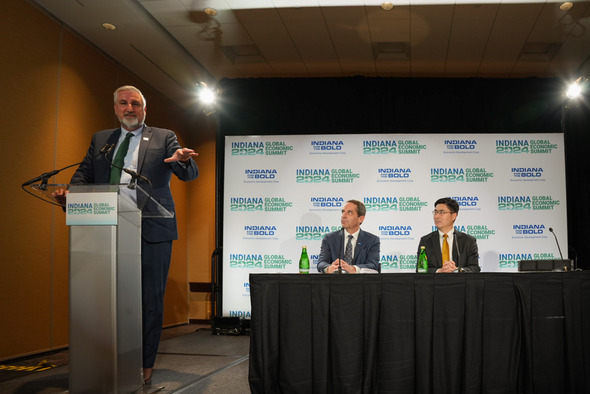
Governor Eric J. Holcomb announced today that Purdue University will partner with Elanco Animal Health and become the newest addition to Indiana’s newly-created OneHealth Innovation District. The announcement was made at Indiana’s 2024 Global Economic Summit after Purdue President Mung Chiang and Jeff Simmons, Elanco CEO, signed a shared memorandum of understanding with the Indiana Economic Development Corporation (IEDC) to establish a globally recognized research innovation district dedicated to optimizing the health of people, animals, plants and the planet.
Purdue and Elanco have committed to develop a new shared-use facility on three acres in the OneHealth Innovation District near the future Elanco Global Headquarters on the western edge of the White River. The facility is designed to deliver and scale-up innovation where industry and academia can collaborate including office, wet lab and incubator space. This is in addition to the nearly complete 220,000 square foot corporate headquarters of Elanco Animal Health, with an expected opening date in the second quarter of 2025. Elanco also announced its commitment to purchase an additional 12 acres from to the north of its existing footprint for future expansion and the development of the Epicenter for Animal Health.
“The research facility will propel the state’s vision to anchor our regional technology hub as a key addition to the One Health Innovation District aimed at accelerating collaborative innovation in our life sciences,” Gov. Holcomb said. “The partnership marks a rare and noteworthy move wherein a global health company, a university and a government come together with a shared vision. The district will create an ecosystem that is focused on talent, applied research and innovation that can be sustained for generations to come.”
Developing the OneHealth Innovation District surrounding the new Elanco Global Headquarters presents a unique opportunity to enable a coordinated partnership between public, private, government, university and community that will attract and retain top talent and drive growth and development for downtown Indianapolis. One Health is recognized by scientific institutions including the World Health Organization and the Centers for Disease Control and Prevention as being a preferred approach to solving for health issues where the interconnection between human, animal and plant science can help solve complex global health problems.
Elanco also announced several commitments to accelerate the OneHealth Innovation District, including a commitment to share technology development capacity in its current Indianapolis facility and eventually in the OneHealth Innovation District. Technical development facilities to bring an idea from proof of concept to pilot manufacturing and then to scale is a unique feature not offered in other animal health development areas and is often a major roadblock in bioscience innovation. Additionally, Elanco plans to contribute up to $2 million of initial funding to jumpstart a new Animal Health Venture Fund to support early-stage innovators, in close coordination with the IEDC to take advantage of available tools and programs that support start-up activity in this space.
“For life-changing innovations to move from idea to reality, they must grow in the right environment,’” said Jeff Simmons, Elanco President and CEO. “The many partners in the Indianapolis’ OneHealth Innovation District will set Indianapolis apart as an area where innovators will find a vast ecosystem of support, including one of the world’s leading universities, funding, lab space, collaboration with many other innovators and companies and most significantly shared technical development and pilot plant facilities to manufacture and scale innovations. We believe connecting innovators with access to world-class, state-of-the-art resources will help bring solutions to some of the world’s most pressing issues facing people, animals and the environment. This is a key milestone in bringing to life our goal of creating an Animal Health Epicenter to reach the world’s animals from our new global headquarters in the heart of Indianapolis.”
The unique partnership is designed to increase the ability to prevent, predict, detect and respond to health threats. One Health integrated approaches are widely recognized as the new frontier in biosciences.
“Totality of Purdue to the totality of Indianapolis – that’s our pledge as the Indianapolis part of Purdue’s main campus officially launches on July 1,” said Purdue president Mung Chiang. “In the coming years, all programs at Purdue will find homes throughout our state’s capital city. Today’s announcement carries a special excitement for the partnership and the location. Purdue is excited to partner with Elanco and other collaborators to build out the ecosystem of OneHealth Innovation District, starting from the building announced and expanding to an entire district. Human health, animal health, plant health will be jointly advanced by the nation’s leading company and our state’s top ranked university.”
The facility will help extend Purdue’s substantial research arm into the heart of Indianapolis, coinciding with the launch of the university’s urban extension, Purdue University in Indianapolis, on July 1. Research interests will include understanding of the microbiome, antimicrobial resistance, computational biology, comparative genomics and livestock sustainability, among others. Indianapolis is home to the biotech companies that are on the cutting edge of the revolution in animal health (Elanco), human health (Eli Lilly & Company) and plant health (Corteva).
Investment designed to support platform development and business growth
Cooperative Ventures has announced an investment in Traction Ag, Inc., a leader in farm accounting technology and developer of the first cloud-based accounting software delivering solutions to farmers across the United States. A joint venture between two leading farmer-owned cooperatives, CHS and GROWMARK, Cooperative Ventures focuses on developing mutually beneficial commercial relationships between startups and cooperative partners. Traction Ag’s $10 million Series A round was led by Cooperative Ventures and joined by Plymouth Growth and existing investors.
Traction Ag provides farmers and ranchers with the functionality and data they need to make critical decisions on the farm. The company’s cloud-based accounting software, coupled with robust data integrations, equips farmers with meaningful insights that can improve farm profitability through better decision-making. The company has experienced success through organic growth, strategic investments and partnerships over the past year. Recently, the company acquired and integrated solutions from Granular and Conservis. These acquisitions are accelerating the build-out of premium and enterprise features within the Traction Ag platform.
“From the very beginning, our priority at Traction Ag has been to deliver value to farmers and give them peace of mind when making decisions,” said Traction Ag CEO Dustin Sapp. “This round of funding will enable us to scale faster, reaching even more farmers with our decision-making solutions that drive real value at the farm gate.” Traction is currently focused on enhancing its business platforms, increasing service offerings and building partnerships in the agriculture industry.
Traction Ag fits in Cooperative Ventures’ farm business enablement focus area. This sector includes tools and technologies, which help farmers manage their complex business operations. “Traction Ag is a compelling investment for Cooperative Ventures,” said Heather Thompson, director of innovation at GROWMARK. “We believe the company has a strong foundation to build upon. Also, the company’s mission to empower financial decision-making and operational profitability is very closely aligned with the missions of both CHS and GROWMARK, making it a natural fit for Cooperative Ventures to support.”
The investment from Cooperative Ventures and Plymouth Growth is a testament to the strength of Traction’s readiness to scale and track record of strong growth. “Traction Ag and its existing investors have built a deep and proven team and a board of directors with strong commitment to and experience in the agriculture sector,” said Plymouth Growth Partner Brook Critchfield. “Plymouth Growth is thrilled to bring more than 20 years of experience in growing category-leading software companies alongside the industry leadership of CHS and GROWMARK in order to help drive Traction’s next phase of growth.”
Through this relationship, Traction can create valuable connections within the vast network of CHS and GROWMARK farmer-owners and customers. “Together with GROWMARK, we believe this investment will equip our owners and customers with essential tools for their businesses,” said Ben Van Straten, CHS innovation director. “Cooperative Ventures was created to focus on innovative solutions and emerging technologies that positively impact agriculture and we believe that Traction has the ability to do just that.”
The bioeconomy – where feedstocks from agriculture are transformed into new products – is poised to surge to more than $30 trillion dollars over the next two decades. The White House calls its potential “enormous,” and there’s an organization leading the effort to create infrastructure around this opportunity. Today, BioMADE Chief Technology Officer, Melanie Tomczak, joins us to tell us 1) what exactly the bioeconomy is, 2) the role of BioMADE in its growth and 3) the unique connection between people, plants and animals.
Where are the greatest opportunities for growth in bioinnovation? Melanie talks cross-sector collaboration and pushing things from early-scale to commercial scale – getting entrepreneurs out of the “Valley of Death.” She also gets into creating resilience and sustainability in U.S. supply chains in a post-pandemic world is also experiencing political unrest and geo instability.
What’s ahead? BioMADE recently named six states (Indiana being one) to a short list of geographies that could fill a need that doesn’t exist in the US today: allowing innovators to start the scale-up process without the investment into new facilities, allowing for emerging technologies and products to flow through the U.S. more quickly.
New for the 2024 crop season, GRAINCO FS is offering myFS Agronomy as its latest digital agronomic tool for on-farm data-driven decision-making for its farmer customers in Kendall, LaSalle, and Grundy counties in Illinois. The new digital platform and app, developed with Intelinair, provides in-season and postseason actionable insights and analytics for improved operational efficiency and return on investment. For years, GRAINCO FS has been at the forefront of providing innovative digital solutions to its customers. The recently launched app available now brings new features and functionality for an improved experience.
“We embarked on our ag tech journey nearly six years ago, driven by a commitment to leverage technology to generate the best return on investment for our customers,” said Alan Drake, General Manager of GRAINCO FS. “Partnering closely with our farmers, we recognized the immense potential of data-driven decision-making and continue to enhance our program to support their operations. Our strategy remains focused on an ever-evolving omni-channel where our growers can connect anytime and anywhere with all aspects of doing business with GRAINCO FS. We are striving for a seamless experience where growers can monitor the health of their fields, pay off a bill, view an open contract, chat with our team – the list only continues to evolve with what our customers need. As we navigate the challenges posed by fluctuating commodity prices this growing season, tools like myFS Agronomy will focus on decision-making that will maximize returns on every acre.”
GRAINCO FS uses the tech platform to analyze the crop on every acre across their entire trade territory to ensure their crop specialists are given the best data to make the decisions during the season to maximize the crop and to understand what seed, inputs, and practices will bring the highest ROI for each acre and in each situation postseason. All of this being built on real, local data gives their customers access to information they have never been able to see.
Cal Mason, Farm Data Manager for GRAINCO FS, said, “Our mission is to do what is best for our farmers. Using myFS Agronomy, we are able to take an unbiased approach, find what works and bring this information to our customers. Whether it’s helping them decide whether or not to replant and making sure their fields are clean or helping them select the best seed and where to plant it, we have taken a 360-degree in-season and postseason approach to partnering with our customers.”
Having several years of experience with this technology, GRAINCO FS has found that providing support to help their customers learn and utilize the product is critically important to their success.
“When a grower decides to partner with us, we make sure we are with them every step of the way ensuring they get the most out of the technology. From training them to use myFS Agronomy and interpreting the data, to making sure each field with a problem has boots on the ground so no opportunity is missed, we are there to support them,” said Morgan Picht, Data Management Specialist for GRAINCO FS.
Crop specialists and the data management team members partner with the customer to review and interpret their field data and from there they decide what actions might be taken, if any.
GRAINCO FS Crop Specialist Jason Hamer said, “My customers want to feel exceptionally confident that they are making the best decisions possible. With the analytics, I know how to direct my customers to make the most profitable decisions for their farm. Together, we are able to look at the information and make decisions we both feel great about.
“One of the most eye-opening things that we are taking action on this year is corn planting populations. I always thought 34K to 36K was good enough, and the analysis, across an astronomical amount of acres, did not show that. The information showed we needed to push certain hybrids harder. This is one of the easiest things we can do to increase profitability.
This chart illustrates the yield by planting population across tens of thousands of corn acres in LaSalle, Grundy, and Kendall counties.
“Looking forward, what makes me most excited is that as more people get on board in our geography, we are creating a community to drive our territory and our yields forward. Each person that joins, builds this data and the community. We all get better because of it,”added Hamer.
“Our long-term vision with our ag tech journey is to partner as consultants with our growers. We strive to be their go-to farm advisor with a committed emphasis on helping determine the best plan for each field. With the information we now have access to, we can customize a field plan based on various factors, including slope, seed, soil type, and many other historical data points,” added Drake. “This allows us to analyze every input to generate the best ROI for every acre. Our digital journey is not one to replace the salesman/grower relationship, either. With the technology at hand, we are working to only enhance our partnerships with our growers to empower them with data analysis to help them make better decisions.”
Conner Schmidt, National Sales Leader for Intelinair, said, “Our goal is to make technology simple enough that anyone can utilize it with analytics that find the answers to two difficult questions – What is the problem and how do I fix it? Analyze is a big step in that direction that this feature will continue to evolve.
“GRAINCO FS has and will continue to play a large role in this innovation. They are a company that relentlessly pursues better solutions for their customers, and they are not afraid to lead the way in uncharted territory. In the early stages of Analyze, they were the first to embrace the information and bring it to their customers. I was able to watch their team use Analyze to consult their growers to make numerous large and impactful decisions last fall which will pay dividends in this challenging market environment. I look forward to working together with GRAINCO FS to push the envelope further,” added Schmidt.
Hemp-derived cellulose offers superior absorption and eco-friendly solutions
The manufacture and discard of traditional superabsorbent materials — typically made from synthetic polymers, primarily polyacrylate-based compounds — are affecting the planet. Purdue University researchers are developing biodegradable materials that retain water in a cleaner, more sustainable way and have much less environmental impact.
Senay Simsek leads a team of researchers in Purdue’s College of Agriculture using cellulose extracted from hemp and refined through a sequence of treatments to create the patent-pending, superabsorbent materials. Simsek is a professor in and the head of the Department of Food Science, and holds the Dean’s Chair in Food Science.
“We are passionate about the potential of our product to make a significant environmental impact,” Simsek said. “By introducing a commercial product that helps save our planet, we aim to lead the way in sustainable innovation — helping to heal the planet one application at a time.”
Drawbacks with traditional superabsorbent materials
Traditional superabsorbent materials are used around the globe in multiple applications including disposable diapers, feminine hygiene products and agricultural water retainers.
“This widespread use exacerbates their environmental impact due to the volume of waste generated and the universal nature of the problems they cause,” Simsek said.
Production of traditional superabsorbent polymers often requires significant energy inputs, which contributes to their overall environmental footprint. Also, they are made from raw materials derived from nonrenewable resources, like petroleum-based products, which also are used to make plastics and various chemicals.
“The reliance on petroleum-based materials in their production is a further concern, as it ties these products to fluctuating oil prices and geopolitical tensions,” Simsek said, noting that this also leads to the depletion of limited resources. “Transitioning to materials like hemp-based cellulose could mitigate this issue by utilizing a renewable resource to produce superabsorbent materials.”
Finally, the waste from used, nonbiodegradable, disposable diapers alone is impacting the planet’s health. The World Economic Forum reported in August 2023 that over 300,000 disposable diapers are incinerated or taken to landfills each minute. Babies use between 4,000 and 6,000 diapers before they are potty-trained. Those numbers don’t include the billions of menstrual pads and tampons discarded annually in the U.S. alone.
Purdue innovative materials
Simsek said hurds and bast are two parts of the hemp plant that offer unique benefits for sustainable material development, particularly in absorption technologies.
“Hemp hurds, found in the inner woody core of the hemp stalk, are highly absorbent due to their high cellulose content and low lignin levels. This makes them an excellent alternative for superabsorbent applications,” she said. “Hemp bast, the fibrous outer layer, while less absorbent, provides strength and durability.”
She added, “The cellulose extracted from these parts is particularly effective because its molecular structure can be modified to enhance its water retention capabilities, making it ideal for products requiring high absorbency.”
Simsek said the Purdue process to refine the cellulose extracted from hemp involves a carefully designed sequence of treatments.
“The treatments break down the natural structure of the cellulose, increasing its surface area and porosity. This enhancement allows the cellulose to absorb and retain more water,” she said. “A fitting analogy would be turning a compact sponge into a more open, fluffy one. This alteration dramatically improves its ability to soak up and hold moisture, which is crucial for applications that demand high absorbency. The uniqueness of our technology lies in its versatility, making it highly tunable for diverse applications of superabsorbent materials across various industries.”
Along with diapers and hygiene products, the Purdue-developed material could be applied to water retention in agriculture.
“For water retention in agriculture, the improved water efficiency helps maintain crop health during droughts, offering a sustainable alternative to traditional superabsorbents that can harm the soil and plant growth,” Simsek said. “Our approach conserves water and supports the ecosystem by providing a biodegradable solution that integrates seamlessly into natural cycles.”
Another application is biosensors used in a variety of industries.
“These include glucose strips and pregnancy tests,” Simsek said. “The versatility stems from the material’s ability to respond dynamically to environmental changes. This trait is essential for timely and accurate biosensing.”
Validation and next steps
Simsek and her team tested the Purdue superabsorbent materials made from hemp using standardized absorbency tests, which compared them against traditional superabsorbent materials such as polyacrylate-based products.
“The hemp hurd, due to its enhanced surface area and porosity from our refining process, showed significantly higher absorption capacity than both hemp bast and many traditional materials,” she said. “This validation underscores not only the effectiveness of our technology but also its potential to replace less sustainable options in the market, offering a biodegradable and renewable alternative.”
Simsek said the next step to bring the superabsorbent materials to the market is to scale up the technology to industrial levels.
“This scaling phase is vital not only for refining our process but also for demonstrating the practical applications of our innovation in agriculture and food packaging, areas where sustainable solutions are urgently needed,” she said.
“We are passionately pursuing further collaborations with industry leaders who share our vision of replacing traditional superabsorbents with our biodegradable, sustainable alternative,” Simsek said. “This support will be instrumental in helping us meet regulatory requirements and achieve widespread adoption, ultimately allowing us to provide future generations with a cleaner, more sustainable way to retain water and reduce environmental impact.”
Simsek disclosed the superabsorbent hemp-based materials to the Purdue Innovates Office of Technology Commercialization, which has applied for a patent from the U.S. Patent and Trademark Office to protect the intellectual property. Industry partners interested in developing or commercializing the work should contact Dipak Narula, assistant director of business development and licensing — physical sciences, at [email protected] about track code 70273.