The Bee Corp recently announced a new series of pilot tests during blueberry pollination season, working with Michigan State University (MSU) entomology professors, Rufus Isaacs and Meghan Milbrath and graduate student, Lauren Goldstein. The pilot project will examine the viability of using The Bee Corp’s Verifli technology to measure honey bee colony strength.
Isaacs leads MSU’s Berry Crops Entomology program and Pollination Ecology, focused on studying the biology and management of economically important insects in blueberries and other berry crops. Dr. Milbrath is a honey bee expert who studies how to improve their health and management. Based on initial testing, the team is encouraged by the potential of Verifli to improve crop pollination and honey bee management.
“Accurately measuring colony size is a challenge because we can’t see inside the hives,” Isaacs says. “In addition to being a slow and imprecise method, opening hives to visually estimate colony size is disruptive to the bees.”
Verifli delivers results by analyzing thermal data through infrared (IR) technology. With a single IR image of the hive exterior, Verifli uses the bees’ thermal signature to determine colony population. Since a hive’s pollination effectiveness is directly tied to colony size, growers who rent bees for pollination can use Verifli’s data to quickly determine whether their hives are strong enough to pollinate the crop.
“The ability to perform accurate, non-invasive colony measurements with the click of a button would be a significant development,” Goldstein says. “Verifli could become a tool for crop consultants, growers and beekeepers.”
Initially introduced in the highly pollination-dependent California almond industry, The Bee Corp has developed a solid foundation to take their learnings and research to other fields, starting with blueberries. With plans to expand into other crop pollination markets, The Bee Corp hopes this pilot study will showcase Verifli’s ability to grade hives accurately and efficiently.
“Since almonds rely on bee pollination more than any other crop, almond growers have invested substantially into researching how to optimize pollination,” says CEO of The Bee Corp, Ellie Symes. “We aim to translate the knowledge we’ve gained in almonds to growers of other crops that depend on bees, where pollination research and innovation are not as heavily funded.”
The Bee Corp’s goal is to demonstrate that Verifli provides an effective tool for blueberry growers during their critical pollination period. Entering a new industry, The Bee Corp looks forward to testing their service to compare data and adapt the platform to solve unique problems faced by growers of different pollination-dependent crops.
“We’re excited for this opportunity to introduce Verifli to more crop growers whose success relies on securing strong hives for pollination,” Symes continues. “Though they pay less per hive than almond growers, other growers who rent bees still deserve to know what they’re paying for.”
“This is one of several pilot studies we’re conducting this year to understand the challenges of expanding Verifli into new crops,” says Symes.
“We’re eager to introduce the value of IR hive grading to more growers who seek to optimize pollination.”
Nearly $10 million allocated since program’s inception, 122 awards to Hoosier companies in 50 counties
The Indiana Economic Development Corporation (IEDC), in partnership with Conexus Indiana, announced the fourth round of awards totaling more than $2.8 million to 34 Indiana businesses in Manufacturing Readiness Grants to support a projected $17.4 million in technology-based capital investment in Indiana.
“Hoosier manufacturers are preparing now for the industries of tomorrow,” said Governor Eric J. Holcomb. “Through the Manufacturing Readiness Grants program, these forward-thinking companies are modernizing their operations to set themselves up for a successful future, creating high-skill, high-wage jobs for Hoosiers in all parts of the state and propelling the long-term growth of Indiana’s strong manufacturing sector.”
The Manufacturing Readiness Grants program was launched in 2020 to stimulate private sector investments to modernize Indiana’s manufacturing sector. Based on the program’s success, the Indiana General Assembly appropriated $20 million in additional funding to the two-year state budget that runs through June 30, 2023, to help position Hoosier operations for future growth and prosperity. Availability of the new funding on July 1, 2021, has enabled a total of 122 awards to date totaling nearly $9.7 million in grants to Hoosier companies in 50 counties, supporting technology-based capital investment projected to be more than $68.6 million.
The 34 grant recipients in this round include companies from 22 Indiana counties and cover a wide range of specialties, including aerospace and defense, automotive, custom electronics and medical devices.
“We continue to be impressed with the applications that demonstrate more and more Indiana manufacturers are embracing and implementing smart technologies to succeed in an increasingly tech-focused environment,” said Mitch Landess, vice president of innovation and digital transformation at Conexus Indiana. “As a partner with the IEDC on these grants, Conexus Indiana and its panel of Smart Manufacturing Fellows review all applications, and we are excited to see technologies such as digital twin, additive manufacturing, collaborative robotics, and IIoT being implemented and impacting both job and business growth.”
Recipients include:
Addman Engineering (Hamilton County; $150,000 grant award) is an additive manufacturing shop at the cutting edge of metal additive for aerospace, defense and other industries. The company will purchase a Velo3D Sapphire laser powder bed fusion additive manufacturing machine for production parts.
Amatrol (Clark County; $158,295 grant award), a company that designs, develops and manufactures technical training systems, is implementing an automated production system consisting of several advanced technologies that are integrated into its plant-wide systems, including autonomous mobile robots, IoT sensors, cloud analytics, mobile monitoring and digital thread elements.
Analytical Engineering Inc. (Bartholomew County; $100,000 grant award), a manufacturer of specialty equipment for engine, exhaust and vehicle development, including analyzers and custom prototypes, is investing in several pieces of hardware, software and custom integration to improve data acquisition and computing speed capability, along with multiple inter-related systems that comprise test cells and instrument manufacturing laboratories.
Armor Plastics LLC (Jefferson County; $75,000 grant award) is a manufacturer of products for integrated circuit manufacturers, touch panel producers, ITO coaters, transit authorities, display manufacturers, and flexible and printed electronics companies. The company is implementing a new manufacturing line to apply its proprietary hard coat for polycarbonate sheet.
Brake Supply Company (Vanderburgh County; $9,000 grant award) is a 74-year-old company operating one of the largest heavy equipment remanufacturing centers in the world. Its area of expertise primarily serves customers in the mining, heavy industrial, marine and construction industries. The company is applying this grant to purchase a piece of specialty instrumentation for instantaneous, non-destructive analysis and identification of carbon, stainless, low- and high-alloy steels.
Brownstown Quality Tool & Automation (Jackson County; $18,250 grant award) is a tooling job shop that supports manufacturing companies by producing small dies, jigs, gauges and specialty automated equipment. The company is investing in a 3D printer for additive manufacturing capability.
Bruce Fox Inc. (Floyd County; $45,000 grant award) has been in business for over 80 years producing high-quality accolades and recognition products for Fortune 500 companies. The privately owned company is upgrading its equipment into the 21st century with the purchase of new printing equipment, 3D scanners and a CNC matt cutter, which will allow the small company to grow in its market and be more competitive.
CHaSE Manufacturing LLC (Elkhart County; $50,000 grant award) is a manufacturer of decorative interior products such as cabinet doors, trim and moldings and doors for recreational vehicle (RV) manufacturers and manufactured housing. The company is investing in tech-enabled equipment, including 3D printing, computer vision, IoT and machine learning.
Cimtech Inc. (Floyd County; $50,000 grant award), a manufacturer to manufacturers, specializing in precision machined parts, fabrication, welding, tube bending and assembly for all types of industries, is investing in a new-to-market, vertical machining center with advanced technology features to expand the company’s capabilities from small precision machined parts up to medium-sized parts.
Diver’s Supply Co. Inc dba Ikelite Underwater Systems (Marion County; $50,000 grant award), an innovative, family-owned manufacturer in the niche market of advanced underwater photographic equipment, including lighting and camera accessories, is purchasing advanced equipment for process development.
Fatheadz Inc. (Marion County; $200,000 grant award), a manufacturer of sun and optical frames, is investing in injection molding and specialty machines for lens production to bring production back to the U.S. from an overseas location in efforts to shorten lead times and increase quality.
Fort Wayne Metals (Allen County; $200,000 grant award) is a manufacturer of precision wire-based materials used in medical devices and other critical applications. The company is investing in a digital plant initiative that will deploy IIoT capability on up to 2,000 machines across 11 plants in Indiana.
Fox Products (Whitley County; $50,000 grant award), a family-owned manufacturer of double-reed woodwind musical instruments, is replacing older, less capable production machines with new routers, lathes and mills with IIoT connectivity for remote monitoring and manufacturing data collection.
Gracie Industries LLC (Whitley County; $30,000 grant award) is a contract manufacturer and painting and coating business that builds custom sleepers for over-the-road trucks, RVs and components, crew cab conversions and other truck modifications. The company is investing in painting robotics and automation.
Holic Foods (Henry County; $25,000 grant award), a manufacturer of globally inspired, bold-flavor sauces, dips and condiments, is modernizing and expanding automated production in its liquid filling space.
Impact CNC (Whitley County; $100,000 grant award) is a contract computer numerical control (CNC) manufacturer for industrial, material handling, construction and agricultural industries. The company is undertaking a significant investment in smart manufacturing technologies, including the integration of a custom manufacturing portal for employees, sensors for machines, cobots and other IT.
Kammerer Dynamics Inc. (Noble County; $65,000 grant award) is a fourth-generation, family-owned metal fabricator specializing in repetitive original equipment manufacturer (OEM) parts and custom equipment manufacturing. The company is adding an automated material handling system over its laser table to eliminate the manual movement of sheet steel.
Liberty Trailers (Putnam County; $100,000 grant award) designs and manufactures commercial-grade trailers suitable for homeowners and businesses such as car and equipment haulers and dump, utility, tilt, flatbed and pipe trailers. The company is investing in fully autonomous, robotic welding cells and increasing internal fabrication capacity.
Mach Medical (Whitley County; $175,000 grant award), an orthopedic implant manufacturer that supplies OEMs and specializes in high-velocity, single-piece flow manufacturing, is deploying digital twin technology, which will radically reduce the time involved in translating customers’ design specifications into executable manufacturing and comprehensively populating the device history record. This technology is also an important aspect of reducing implant inventory for Mach’s customers.
Omega Enterprises (Randolph County; $187,500 grant award), a family-owned and operated glass mold manufacturer, is modernizing its welding techniques by investing in an automated laser cladding welder system with advanced technologies.
Ossian Smoked Meats Corp. (Wells County; $50,000 grant award), a 74-year-old preparer of meat products with seasoning, smoking and packaging for resale, is investing in an automated saw and weight packaging machine.
PDQ Workholding LLC (Whitley County; $75,000 grant award) is a tool shop specializing in hydraulically actuated machining center fixtures and custom cutting tools for large OEMs in automotive, equipment and aerospace industries. The company is investing in two production-grade 3D printers to migrate its fixturing products from steel fabrication to carbon fiber.
Poly Electronics LLC (Elkhart County; $40,000 grant award), a manufacturer of custom electronics and proprietary products for various industries, is investing in automated soldering and conformal coating equipment, along with inventory staging equipment to replace manual processes.
Procoat Products (Jefferson County; $100,000 grant award), a custom electrocoating and flocking provider that services the automotive industry including Cummins, Ford, General Motors, Lexus, Mercedes Benz and Toyota, is investing in technology to fully automate its current e-coat line by adding a programmable automatic parts transfer hoist, robots and other data collection devices.
QuikCut (Allen County; $50,000 grant award), an advanced metal fabricator offering fabrication, machining, welding and finishing for small parts and large structures, is investing in a new robotic weld cell to qualify as part of the manufacturing supply chain producing products for major telecommunications providers.
Reliable Tool & Machine Company (Noble County; $10,000 grant award), a machining, welding and assembly manufacturer for construction, agricultural, recreational vehicle (RV) and marine, and lawn care industries, is investing in computer systems to support the latest labor-tracking software and adding a module to reduce reliance on handwritten documentation.
Rochester Metal Products Corp. (Fulton County; $25,000 grant award), a manufacturer of quality gray and ductile iron castings, is investing in a cobot to automate part of its production process.
Sequel Wire and Cable LLC (Marshall County; $6,710 grant award) is a startup company and manufacturer of copper fabricated and insulated wire and cable products for use in a variety of markets including OEM, wire and cable distribution, appliance, automotive and RVs. The company is implementing automated data collection on production machines across its facility.
South Bend Ethanol (St. Joseph County; $87,000 grant award), an ethanol producer that uses 95% local corn, is investing in technology to pull 25,000 data points from several manufacturing process sources into a central plant information system to make better decisions relating to plant reliability and output.
Super ATV (Jefferson County; $50,000 grant award), a family-owned and rapidly growing manufacturer of aftermarket utility task and all-terrain vehicle parts and accessories, is investing in a portable coordinate measurement machine (CMM) arm, mill and lathe to shorten cycle time and improve the company’s new product development and innovation process.
Tech Castings LLC (Hancock County; $171,500 grant award) is a leading supplier of vacuum and air melt superalloy investment castings and pressurized ceramic core leaching services to aerospace companies. The company is implementing robotics in its shell room to increase capacity and quality while alleviating employees its workers from lifting heavy items.
Thompson Machining Services Inc. (Franklin County; $76,600 grant award) is a 25-year-old machine shop with engineering and design capabilities specializing in producing progressive stamping dies, primarily for the medical and automotive industries. The company is investing in an additional milling center and is expanding further into additive manufacturing with a new 3D printer for production parts.
Triton Metal Products Inc. (Steuben County; $135,000 grant award), a precision metal manufacturer and supplier of OEM parts for various industries, is investing in automated material handling equipment to streamline productivity, which will create more tech-oriented and high-skilled positions.
Whitcraft Enterprises Inc. (Allen County; $150,000 grant award), a 101-year-old manufacturer of precision machined parts, is investing in a gantry-style automated dual lathe to eliminate the manual loading of materials.
Indiana companies are encouraged to review eligibility requirements and submit applications online.
Grants must be matched by the applicant on a minimum 1:1 basis. Grants undergo a rigorous peer review and recommendation process by a statewide committee of manufacturing professionals representing industry, academia, private equity and more.
The City of Bloomington has received a $3.5 million CARES (Coronavirus Aid, Relief, and Economic Recovery) Act Recovery Assistance grant from the Economic Development Administration (EDA) of the U.S. Department of Commerce. This grant will support construction of the Trades District Technology Center, which will facilitate the growth and commercialization of second stage, tech-based businesses. The City applied for the grant in partnership with the Bloomington Economic Development Corporation, and the EDA funds will be matched by $1.6 million of local investment. The EDA estimates that the grant will create 530 jobs and generate $51 million in private investment in the region.
“We are extremely gratified to see this federal investment in our community’s economic future,” said Mayor John Hamilton. “As Bloomington’s economy has evolved toward the tech sector, the City has made strategic investments such as the redevelopment of the Trades District to ensure that our entrepreneurial ecosystem scales up to attract employers and grow jobs for all, across many sectors. We’re glad to be able to partner with the BEDC to establish a tech center that will amplify these efforts toward our community’s sustainable economic development.”
“The Trades District Technology Center will connect local tech companies to regional, national, and international partners and resources,” said Jennifer Pearl, president of the BEDC. “By helping post-startup tech firms grow, this project will also help advance our region.”
The proposed Trades District Technology Center, to be located in the downtown Trades District, will support regional employment growth and economic development in the emerging technology sector. The center will create a hub for technology companies that are beyond the startup phase, with services and space for both growing and mature firms.
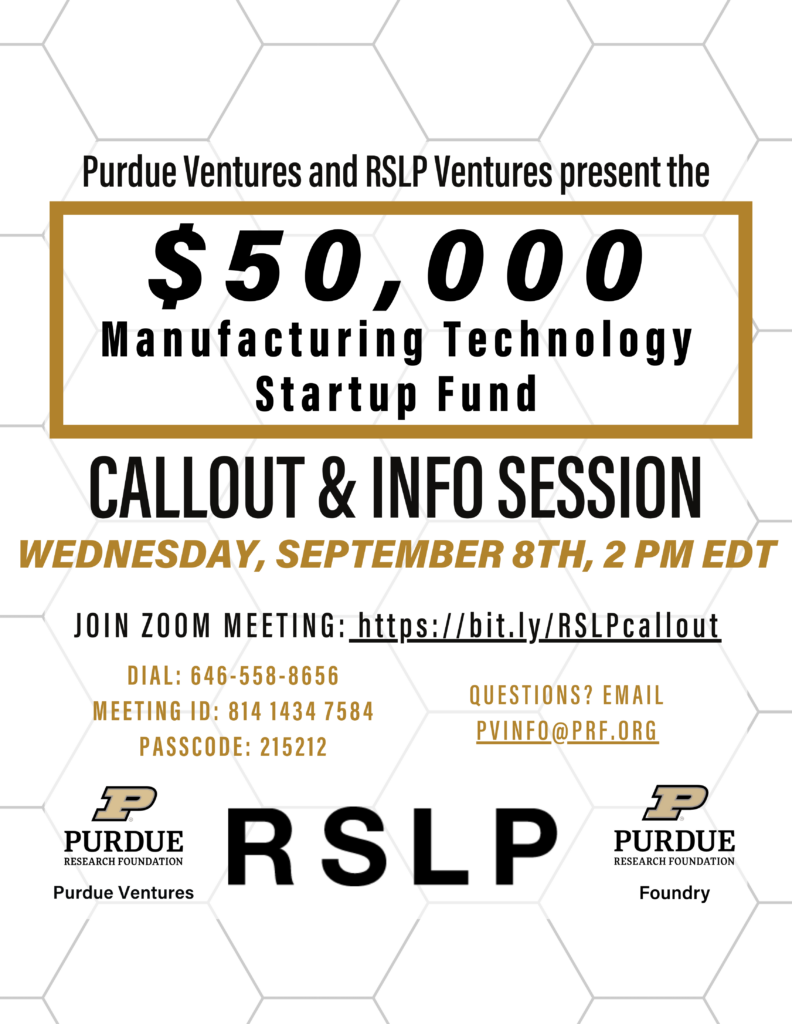
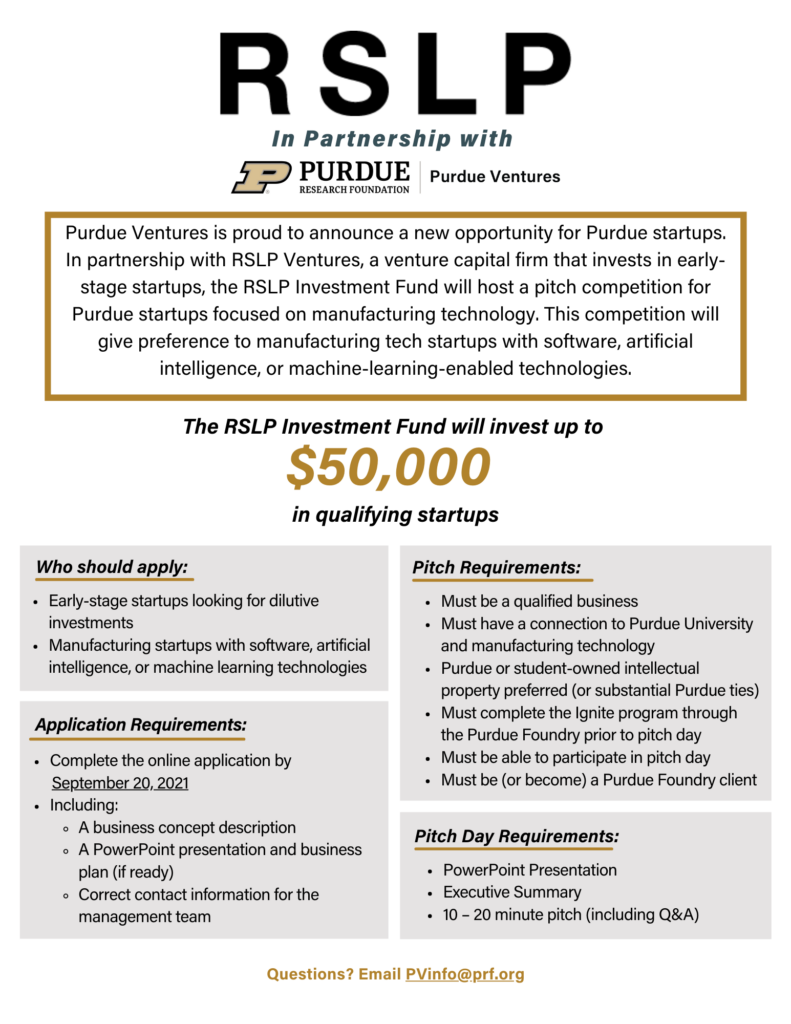
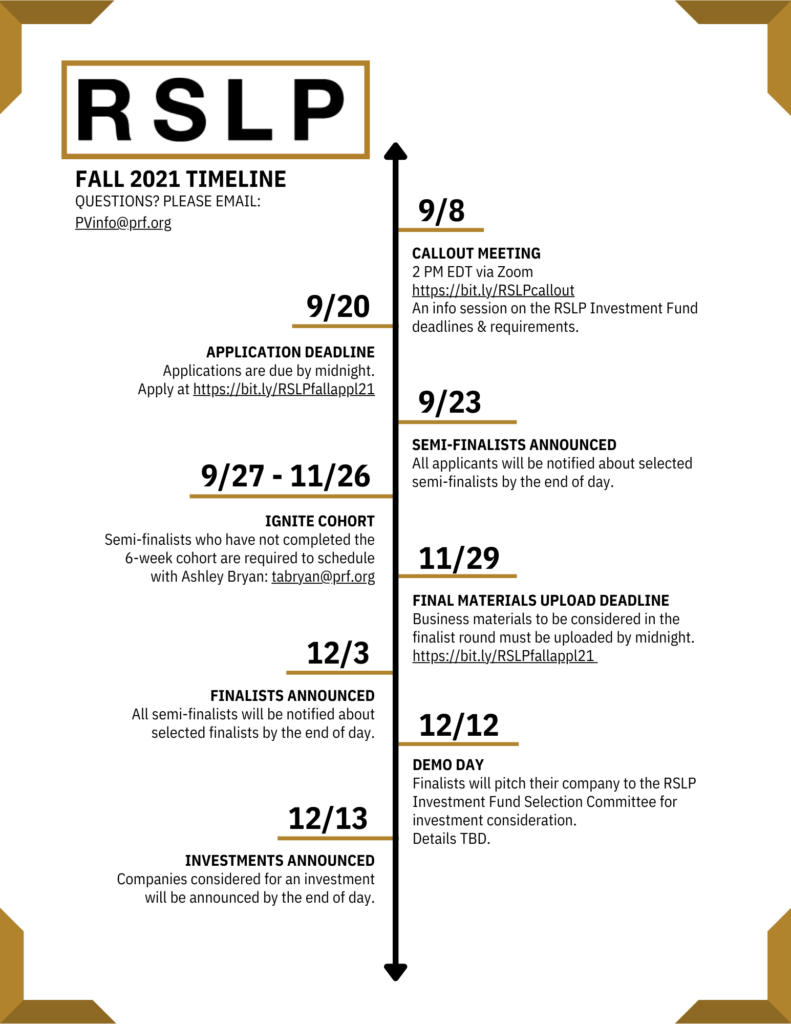
Questions? Attend the callout on September 8th.
Want to talk with Purdue Ventures? Contact us at [email protected]
Click here to apply for the $50,000 RSLP Manufacturing Technology Startup Fund.
Indiana’s venture capital investment in the first half of 2021 exceeded annual totals of both 2019 and 2020, according to the 1H 2021 Indiana Venture Report released today by Elevate Ventures.
Venture capital investment in the state increased 302% compared to the first half of 2020, from $176 million to $708 million. Much of the activity can be attributed to a surge in later-stage deals (greater than $10 million), with 10 occurring in the first half of 2021, up from four during the same period in 2020.
The rise in later-stage deal activity was driven by an influx of out-of-state investment and pent-up demand from the post-pandemic recovery.
“Indiana’s strong start to 2021 indicates a substantial recovery following the pandemic,” said Elevate Ventures CEO Chris LaMothe. “Our state has emerged as a significant player in the regional and national venture capital industry, and we anticipate more success in our continued efforts to support innovation and drive economic growth.”
Other findings in the report include:
Indiana accounted for 0.4% of venture capital dollars invested in the United States in the first half 2021, compared to 0.3% in all of 2020;
The business-to-business (B2B) tech sector accounted for nearly half of all venture capital investment dollars in Indiana and captured 58% of deal activity;
Deal activity in Indiana was second only to Illinois across the Great Lakes and Midwestern region;
Activity in the South Central, West Central, and North Central regions of Indiana likely resulted from university efforts to develop ventures in the regions;
Indiana companies are thriving from a strong post-pandemic economic rebound and a robust venture market.
The 1H 2021 Indiana Venture Report provides a mid-year assessment of venture investment activity in Indiana. While the majority of venture capital activity in the state focuses on technology, the report includes all sectors. New to the report this year is a special feature on diverse investors and founders of venture-backed companies across Indiana.
The University of Notre Dame’s Engineering Innovation Hub (EIH) has opened its doors to students and industry partners. The new 10,000-square-foot facility offers a state-of-the-art experiential learning and advanced manufacturing environment with first-rate resources for collaboration, fabrication, automation, robotics and modeling.
Located on the first floor of Cushing-Fitzpatrick Halls of Engineering, the EIH features modern ideation and project space, fabrication and machining technology, advanced manufacturing stations, 3D printing stations, metrology and computing resources, and assembly space.
The EIH is a component of Notre Dame’s iNDustry Labs, which forges partnerships among the region’s leading industries, the University and other colleges and universities to support a more prosperous South Bend-Elkhart region. iNDustry Labs is an anchor of the LIFT (Labs for Industry Futures and Transformation) Network, established with a 2019 grant awarded to Notre Dame from Lilly Endowment Inc. The EIH was made possible with generous support from this grant and investments from industry partners and individual benefactors.
Students will benefit from the EIH either through classwork and research or as members of student clubs and organizations engaged in everything from robotics and satellites to biodesign and assistive technology. With access to EIH resources, students will consider new solutions to practical and meaningful engineering challenges, taking products from concept to realization.
The new facility will help ensure that students graduate with the experience and skills needed to remain competitive in a wide variety of careers, said Daryl Peterson, managing director.
“This EIH is game-changer for our students,” he said. “This remarkable facility will help prepare future engineers who are not only technical experts, but also people who harness creativity and innovation throughout their careers and to serve a world in need.”
Peterson recently joined Notre Dame from Deere & Co., where he served for more than two decades in operations. He oversees the EIH’s technology, programs and outreach in support of its dual mission of academic and industry engagement.
The new facility also will serve as a fabrication and test facility for graduate and undergraduate research and as a resource for local and regional manufacturing industry partners and startup businesses.
“We’re excited that this new facility is not only a powerful resource for our students, but also an opportunity to partner with others in supporting our region’s economic development,” said Patricia Culligan, the Matthew H. McCloskey Dean of the College of Engineering. “Forging closer ties among industry and other colleges and universities benefits all of us. We’re grateful to the many who helped turn the dream of this facility into a reality.”
For animal breeding and reproduction, the needle hasn’t moved much in recent years…until now. On this week’s episode of the podcast, Gerry Dick with Inside INdiana Business talks with Liane Hart, Founder and CEO of Verility, about their AI technology Fertile-Eyez.
They dive into purposing human health technologies for animal health, building a business in Indiana’s agtech ecosystem and advice for entrepreneurs with great ideas that need to materialize.
In an effort to nurture a regional innovation ecosystem and advance research from the lab to market, the National Science Foundation has established a Great Lakes Innovation Corps Hub. Purdue University plays a leadership role in the new $15 million hub.
The 11-university hub is led by the University of Michigan (U-M), and it’s one of five across the country that NSF announced Wednesday (Aug. 25) as it continues to evolve the I-Corps program. Launched in 2011, I-Corps trains scientists and engineers to carry their promising ideas and technologies beyond the university and into the marketplace to benefit society.
In addition to the principal and partner institutions, U-M, Purdue, the University of Illinois Urbana-Champaign (UIUC), and the University of Minnesota, the Great Lakes Hub includes as affiliates the University of Chicago, the University of Wisconsin-Milwaukee, Iowa State University, Michigan Technological University, Missouri University of Science and Technology, the University of Toledo and the University of Akron.
“A critical part of research at Purdue is the translation of discoveries and advances that have the potential for significant impact on society,” said Theresa Mayer, executive vice president for research and partnerships at Purdue University and Purdue’s principal investigator on the I-Corps Hub. “Purdue is thrilled to continue to be part of the NSF I-Corps program and to join with universities throughout the Great Lakes region in support of our collective mission to accelerate the time to commercialization.”
Boosting Midwest Innovation
In coastal cities, entrepreneurship and innovation often thrive organically because significant numbers of investors and innovators operate in close proximity to collaborative opportunities and pathways for developing research. The Great Lakes Hub aims to connect people at a large scale to increase the “effective density” of the Midwest’s innovation ecosystem.
“The Great Lakes region is home to many of the world’s leading research institutions, and many of our nation’s critical industries. Our goal with this I-Corps Hub is to leverage this intellectual depth to create a lasting economic impact on the region,” said Alec D. Gallimore, the Robert J. Vlasic Dean of Engineering, the Richard F. and Eleanor A. Towner Professor, an Arthur F. Thurnau Professor, and a professor of aerospace engineering at the University of Michigan.
“We’ll do this by creating new businesses, by keeping our existing companies globally competitive and on the leading edge of technology and by developing talent that not only has technical and cultural expertise, but also an entrepreneurial mindset,” Gallimore said.
Over the past four years, the Midwest I-Corps Node, a collaboration between U-M, Purdue and UIUC, has introduced the entrepreneurial mindset to over 3,000 scientists and engineers across the Midwest, and it has helped teams assess the commercial potential of nearly 1,000 technologies.
The new Hub has set a goal of training 2,350 teams in the next five years, and sending an additional 220 teams to the National NSF I-Corps program.
Growing Purdue’s Commercialization Enterprise
Purdue’s participation in the NSF I-Corps program dates back to the award of an I-Corps Site in 2015. Led by the Krannert School of Management, the I-Corps Site has been a collaborative initiative with co-PIs from the College of Engineering, the Purdue Polytechnic Institute, the Office of Technology Commercialization, the Purdue Foundry, and the Burton Morgan Center.
Purdue’s I-Corp programs, offered through the Krannert School of Management, the Purdue Foundry, and the Burton Morgan Center, prepare teams of researchers to participate in the National I-Corps program, an intense seven-week program designed to enable teams of scientists, engineers, and researchers to understand the potential value of their technology and inventions to society. Purdue’s I-Corps Site has been an important contributor to Purdue’s commercialization enterprise. More than 200 Purdue teams have engaged in I-Corps, many of which have gone on to form companies and raised more than $100 million in follow-on funding.
“During the last six years, Purdue’s engagement with both I-Corps and NSF’s National Innovation Network has been integral to the reimagining of the university’s innovation process from invention to commercialization,” said Matthew Lynall, Purdue clinical professor of management, who serves as the PI for Purdue’s NSF I-Corps Site, and co-PI for the Great Lakes I-Corps Hub. “I-Corps has helped our researchers understand and advance the commercial potential of their research and has provided critical perspective as they determine the next steps in their path to commercialization.”
In addition to Lynall, who was recently appointed as the Avrum and Joyce Gray Director of the Burton Morgan Center for Entrepreneurship at Purdue, other university leaders and researchers play critical roles in the program. Professor Nathalie Duval-Couetil, professor of human resource development and director of Purdue’s Certificate in Entrepreneurship and Innovation, is the hub research lead. Yung-Hsiang Lu, electrical and computer engineering professor and director the John Martinson Entrepreneurial Center, is the faculty lead and will work to connect faculty members to the I-Corps community.
Taylor Farms enters the greenhouse growing market with an investment in South Bend-based Pure Green Farms. This expansion into greenhouse grown fresh offerings will complement Taylor Farms’ existing 122,200 crop acre field grown program and 16 salad producing facilities across North America.
“We’re excited to venture into the industry of indoor growing with this investment,” said Bruce Taylor, Founder and CEO, Taylor Farms. “Our customer partners have asked for a national solution and this is our first step.”
Pure Green Farms’ already established facility located in South Bend, Indiana, is a climate-controlled environment equipped with high-tech machinery that grows, packs and ships leafy greens year-round. Pure Green Farms’ first harvest was in March 2020 and operates on a site that can potentially expand up to 300 acres. This operation produces the most popular and great tasting greenhouse leafy green varieties in the most efficient automated greenhouse system.
“We are thrilled to work alongside an industry leading company like Taylor Farms,” said Joe McGuire, CEO Pure Green Farms. “We know this is just the beginning of a fantastic relationship with Taylor Farms and we’re looking forward to continuing to address the increasing demand for local product offerings.”
Value-added food and nutrition is Indiana agbioscience’s largest platform, representing $29.1 billion in annual output and responsible for over 53,000 jobs.