
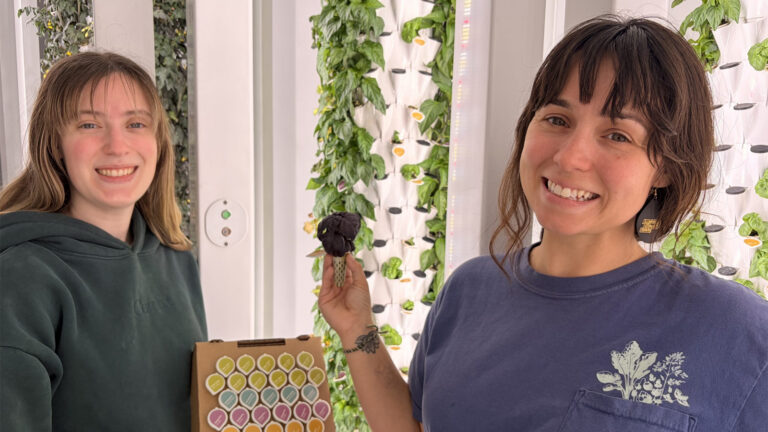
Manmade seed pods grow in a planting port without additional user input or horticultural knowledge
Anu™, a modular indoor farm and consumable seed pod supply company, has received a $500,000 Phase IIB Small Business Innovation Research (SBIR) grant from the National Science Foundation (NSF).
Purdue University alumni Scott Massey and Ivan Ball met while developing NASA-funded, controlled-environment hydroponic chambers. They co-founded Anu, which is a “Food is Medicine bolt-on solution.”
Massey said, “Food is Medicine is an emerging market focused on applying nutrition in clinical, evidence-driven settings and measuring whole-health outcomes. Anu’s agricultural technology therefore becomes healthcare infrastructure.”
The SBIR grant will be used for multi-cavity tooling of the Anu-patented, compostable Plug-and-Grow™ Seed Pods which are shelf-stable. The seed pods, to be manufactured at Goodwill of Central & Southern Indiana, are preloaded with seeds and nutrients; seed varieties include leafy green vegetables, fruiting plants, herbs and flowers.
Pods plug into a planting port, are water activated by the automated growing system, and grow without additional user input or horticultural knowledge.
“This presents an order-of-magnitude labor improvement for indoor farming,” Massey said. “It consolidates skilled-labor-intensive agronomy, nutrients and nursery seedling germination management into a turnkey consumable usable in both Anu systems as well as hydroponic systems agnostically through Open Garden Upgrade.”
“Multi-cavity seed pod production makes decentralized Food is Medicine programs easier to deploy, replicate and expand across health ecosystems, now supported with our unconstrained, automated manufacturing line capable of producing millions of seed pods annually.”
The grant also supports testing to quantify the nutritional quality of Anu-grown Pure Produce® grown closer to consumption. Massey said previous testing showed it has approximately twice the average nutrient density of store-bought equivalent red leaf lettuce varieties, with certain nutrients such as Vitamin B measuring as much as 10 times higher.
“The Phase IIB work will expand this evidence base as Anu scales its Food is Medicine platform where the objective is not simply to produce more food, but to reliably produce and validate the nutritional outcomes healthcare providers are ultimately seeking,” he said.
The Phase IIB grant follows Anu’s NSF SBIR Phase I and II grants for $256,000 and $970,993, respectively, and matching funding from Elevate Ventures. The company also received financial support from Purdue Research Foundation.
Food is Medicine efforts
Massey said rather than ask a hospital or clinic to become an expert farmer, Anu provides a standardized, automated cultivation platform that delivers food-production outcomes predictably and with dramatically less specialized agricultural labor.
“Anu’s manufactured seed pods are designed to abstract those agricultural inputs into a standardized consumable,” he said. “This enables controlled-environment cultivation to be overseen by existing health and nutrition professionals, including dietitians.”
Massey said the pods also can be operated by non-specialist labor such as a student apprentice, rather than a dedicated, skilled agricultural manager.
“Our solution reconnects society broadly to sustainably growing the most flavorful and nutritious food,” he said. “The massive leap in labor efficiency also conserves time and empowers all people to grow Pure Produce.”
Massey said the Phase IIB award therefore scales more than a manufacturing process.
“Our long-term objective is to convert controlled-environment agriculture from a skilled-labor-intensive, outcome-driven production business into a standardized outcome-driven system,” he said. “Plug-and-Grow Seed Pods provide the agronomic inputs, Anu cultivation systems control the growing environment, and healthcare and education partners can focus their labor on nutrition, patient engagement, learning and measured outcomes.”